
 |
| Place of Origin: | Hebei, China |
| Brand Name: | H&F |
| Certification: | ISO-9001 |
| Model Number: | HF-CLF007 |
| Minimum Order Quantity: | 200 Square Meters |
|---|---|
| Price: | USD2.5-8.8 per square meter |
| Packaging Details: | Wrapped by plastic film, then on pallets |
| Delivery Time: | According to order quantity |
| Payment Terms: | T/T, Western Union, MoneyGram |
| Supply Ability: | 100000 Square Meters per month |
| Product Name: | Galvanized Chain Link Fence | Material: | Galvanized Wire |
|---|---|---|---|
| Color: | Silver | Surface Treatment: | As Required |
| Height: | 1.8m, 2.4m, 3m, Etc | Application: | Defining Boundaries |
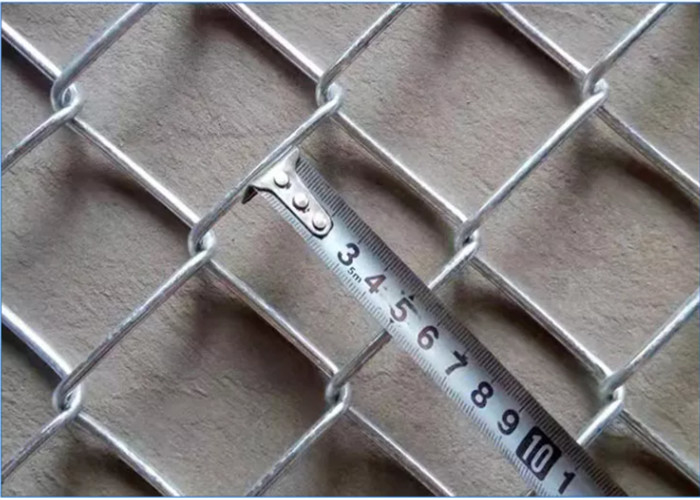
| Hole Size: | 50 X 50mm | Length: | 5-30m |
| Wire Diameter: | 3-5mm | Post Type: | Square Post, Round Post, Etc |
| High Light: | 50 x 50mm six foot chain link fence,diamond six foot chain link fence,defining boundaries chain wire fencing |
||
50 x 50mm Hole Galvanized Chain Link Fence For Defining Boundaries
Product Description
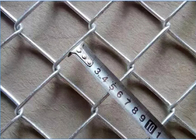
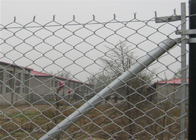
Chain Link Fence is also named diamond wire mesh with the diamond opening. It is made with various metal
wires weaving by chain link fence machine. Our chain link fence materials are available in stainless steel,
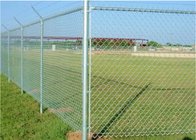
galvanized, and PVC coated wire. They are normally used in gardens, sports yard, industrial sites, houses,
roads and events for crowd control.
Chain Link Netting Edge Types
There are three edge types : knuckle - knuckle, twist - twist or knuckle - twist. Chain link fence with twist will usually add security.
Knuckling - This term is used to describe the type of selvage obtained by interlocking adjacent pairs of wire ends and then bending
the wire ends back into a closed loop. Usually knuckle is standard unless otherwise stated.
Twisting - This term is used to describe the type of selvage obtained by twisting adjacent pairs of wire ends together in a closed helix
of 1-1/2 machine turns, which is equivalent to three full twists, and cuffing the wire ends at a sharp angle to provide sharp points.
The wire ends beyond the twist shall be at least 1/4 inch(6.4mm) long.
Product Specifications
|
Chain Link Mesh Fence
|
|||
|
Mesh |
Wire Diameter | Width | Length |
| 40*40 mm | 1.8 - 3.0 mm | 0.5 - 4.0m | 5 - 25 m |
| 50*50 mm | 1.8 - 3.5 mm | 0.5 - 4.0m | 5 - 25 m |
| 60*60 mm | 1.8 - 4.0 mm | 0.5 - 4.0m | 5 - 25 m |
| 80*80 mm | 2.5 - 4.0 mm | 0.5 - 4.0m | 5 - 25 m |
| 100*100 mm | 2.5 - 4.0 mm | 0.5 - 4.0m | 5 - 25 m |
Product Fetures
1. Anti-rust, anti-corrosion.
2. Modern design and attractive surface.
3. Easy installation, cost effective.
4.Visibility, durable.
5.Weather resistance, maintanance free.
6. High strength, long service life.
Product Applications
Product Installation
The installation of chain-link fence involves setting posts into the ground and attaching the fence to them. The posts
may be steel tubing, timber or concrete and may be driven into the ground or set in concrete.
End corner or gate posts, commonly referred to as "terminal posts", must be set in concrete footing or otherwise anchored
to prevent leaning under the tension of a stretched fence. Posts set between the terminal posts are called "line posts" and
are set at intervals not to exceed 10 feet.
The installer attaches the fence at one end, stretches it, and attaches at the other, easily removing the excess by "unscrewing"
a wire. In many cases, the installer stretches a bottom tension wire, sometimes referred to as "coil wire", between terminal posts
to help minimize the in and out movement that occurs at the bottom of the chain-link mesh between posts.
Top horizontal rails are used on most chain-link fences, although not necessary if the terminal posts are braced correctly.
and for taller fences, like 10 feet or more, intermediate horizontal rails are often added.
Finally, the installer ties the fence to the line posts and rails with steel or aluminum wire with a hook on one end called “Fence Ties”.
The bottom tension wire should be secured to the line posts.
Product show

Packaging and delivery
Contact Person: Mr. Harrison
Tel: 86-318-5280569
Fax: 86-318-7866320
Address: Industrial zone, South of Anping Town, Hengshui, Hebei, China
Factory Address:Industrial zone, South of Anping Town, Hengshui, Hebei, China